
Greece Eases EES Rules for UK Tourists as Spain & Canary Islands Face Travel Chaos
Published 21 April 2026 at 14:46
By: Mr TravelON
Greece has moved to ease EES pressure for British travellers, offering a smoother arrival experience ahead of summer 2026. Meanwhile, Spain and the Canary Islands face growing concerns over delays, missed flights, and the real impact of Europe’s new border system on tourism confidence.
Standfirst: Greece has moved to ease Entry/Exit System pressure for British travellers ahead of the summer rush, raising fresh questions for Spain and the Canary Islands after weeks of delays, missed flights and mounting concern over whether the EES is fit for purpose.
By Mr TravelON | TravelON World
What we know
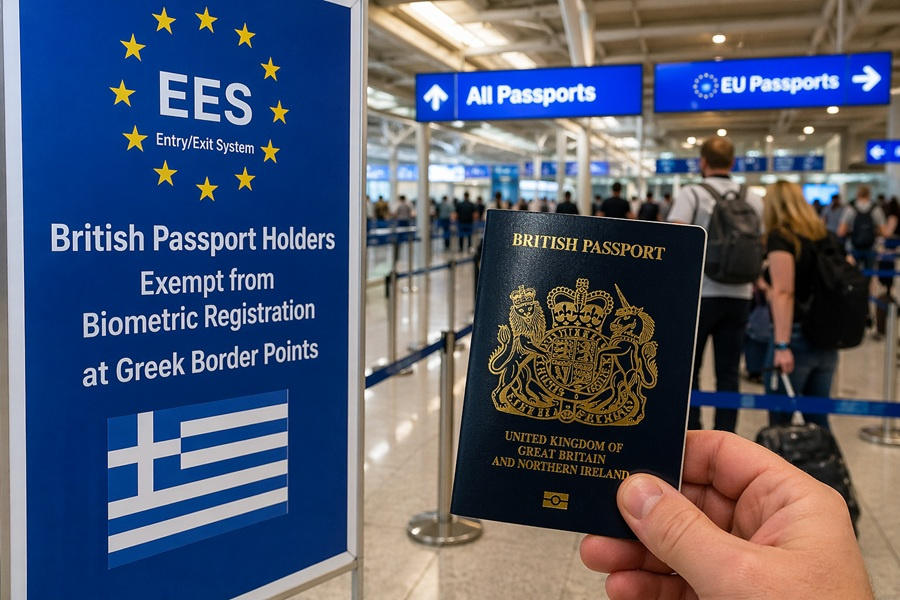
- Greece has publicly said British passport holders are excluded from biometric registration at Greek border crossing points.
- The move comes after mounting disruption linked to the EU Entry/Exit System across parts of Europe.
- More than 100 easyJet passengers were left behind in Milan after passport control delays linked to the new checks.
- The European Commission says the EES is fully operational across participating states from 10 April 2026.
- Industry groups have called for wider flexibility, including partial suspension where queues become unmanageable.
- The row raises new pressure on Spain and the Canary Islands, where EES disruption has already damaged confidence among travellers.
What happened
Greece has become the centre of the latest European travel row after publicly confirming that British passport holders are excluded from biometric registration at Greek border crossing points under the Entry/Exit System, a move widely seen as an attempt to protect summer tourism and reduce pressure at busy airports and island gateways.
The development matters far beyond Greece. British visitors remain one of the most important non-EU source markets for southern Europe, and any country that appears to offer a smoother arrival experience this summer could gain a clear competitive advantage.
For Spain and especially the Canary Islands, the timing is politically and commercially awkward. Mr TravelON has reported since day one that the EES rollout has created confusion, queues, bad publicity and unnecessary travel anxiety for holidaymakers. In a destination built on repeat tourism, easy arrivals matter. Long waits, broken flows and stories of missed flights do not.
Why this matters for travellers
For British tourists deciding where to book next, this is no longer just a technical border-control story. It has become a confidence story.
If one destination is seen to be easier, quicker and less stressful while another is linked with delays, bottlenecks and airport chaos, booking behaviour can shift very quickly. Families, older travellers and short-break passengers are especially sensitive to uncertainty at the airport. They want to know one thing: will I get through without my holiday beginning or ending in a queue?
That question now hangs over Spain and the Canary Islands. The Canaries are not just another summer sun market. They are a year-round destination with heavy reliance on British traffic. If travellers begin viewing some destinations as easier while others are linked to EES hassle, the effect could be felt in bookings, sentiment and repeat business.
Why Greece’s move matters so much
Greece is not a minor player in this debate. It is one of Europe’s tourism heavyweights and Britain is one of its most valuable markets. Reports this year indicate that UK arrivals to Greece in 2025 rose to around 4.89 million, while receipts from British visitors were approximately €3.74 billion. In simple terms, Athens has every incentive to avoid border friction becoming a summer booking deterrent.
That is why this move has landed so hard across the travel industry. Whether officials describe it as a practical operational adjustment or a tourism-protection measure, the message to the market is clear: Greece does not want airport delays becoming the story of summer 2026.
Mr TravelON says Spain should be studying that lesson carefully. The Canary Islands have effectively been one of the most visible test beds for the EES because of their strong year-round British demand, concentrated arrival waves and high dependency on smooth airport processing. The result so far, he argues, has been a shambles that has done reputational damage far beyond the terminals themselves.
The easyJet Milan warning Europe cannot ignore
If anyone still needed proof that EES disruption can have real-world consequences for passengers, the Milan Linate case delivered it.
More than 100 passengers travelling on an easyJet service from Milan to Manchester were left behind after long passport-control delays linked to the new system. Reports said 122 passengers missed the flight after queues of up to three hours. In one account, only 34 of the 156 booked passengers managed to board, leaving many stranded and facing extra costs getting home.
That story cut through because it turned an abstract policy debate into something instantly recognisable for ordinary travellers: turn up early, do everything right, still miss your flight.
That is exactly why Mr TravelON has consistently argued that the EES is not fit for purpose in its current real-world form. A border system is only as good as its execution at busy tourist gateways. If it produces missed departures, stress, confusion and terrible headlines, then travellers will judge it by those outcomes, not by policy paperwork.
What Brussels says
The European Commission’s public position remains that the EES became fully operational across participating countries on 10 April 2026. Under the system, eligible non-EU short-stay travellers are to have entries and exits recorded digitally, with facial images, fingerprints and travel-document data collected as part of the process.
That matters because it shows the legal and political tension now opening up. Greece may be trying to ease pressure for one major inbound market, but Brussels has made clear that the EES is a common external border system, not something designed for selective use based on whichever nationality matters most to a destination’s tourism economy.
Industry reporting has also pointed to temporary flexibility measures, including the possibility of partial suspension for a limited period where operational conditions require it. But the wider dispute appears to be over how far that flexibility can go and whether it can be applied in a way that effectively favours one nationality over another.
The problem for Spain and the Canary Islands
This is where the story becomes especially relevant for TravelON World readers.
Spain has some of Europe’s busiest leisure airports and the Canary Islands depend heavily on efficient flows for British and Irish traffic. In the Canaries, the problem is not theoretical. There have already been repeated concerns about queues, processing times, negative social media posts and poor headlines that travel far beyond the destination itself.
Mr TravelON has been covering the issue in depth since the first warnings, highlighting how concentrated arrival banks, limited staffing, unfamiliar procedures and kiosk slowdowns can quickly create pressure. He has also warned that the damage is not only operational. It is emotional and commercial too. Travellers who see airport chaos, three-hour waits and missed flights in their feeds may rethink where they book.
That leaves Spain facing a serious strategic question. If Greece is seen to be taking practical steps to protect summer arrivals while Spanish gateways continue to absorb the bad publicity of EES disruption, does Spain risk losing bookings at the margin to destinations perceived as easier?
Is the EES fit for purpose?
Supporters of the EES argue that the system has legitimate goals. The European Commission says it strengthens border security, helps detect overstayers, improves identity verification and replaces manual passport stamping with a digital record.
But those claims do not answer the core traveller question: is the live airport experience actually working?
Mr TravelON’s answer is blunt. Right now, he says, the EES is not fit for purpose. Not because border management should not modernise, but because a system imposed at scale on leisure-heavy gateways without consistent smooth delivery risks harming the very destinations that rely on easy access most.
For the Canary Islands, that criticism cuts especially deep. The islands thrive on convenience, loyalty and repeat custom. They do not need another barrier, another uncertainty or another piece of bad press attached to arrival and departure. If the system continues to generate queues and negative headlines, it becomes not only a border-control issue but a tourism competitiveness issue.
What should happen next
Mr TravelON is urging Spain to push for the maximum operational flexibility available and, if necessary, follow Greece in seeking relief from procedures that are clearly harming passenger flow and destination confidence.
He argues that the industry needs honesty, not spin. If queues are excessive, say so. If the technology is slowing people down, admit it. If airports need more staff, more manual intervention or a temporary rollback to protect the summer season, then officials should act before more flights are missed and more reputational damage is done.
The travel trade knows perception matters. Once a destination becomes associated with border hassle, the impact spreads quickly through social media, family recommendations, online comments and booking choices. That is particularly dangerous for islands and package-holiday destinations competing hard for value-conscious British travellers.
Analysis
The biggest risk for Spain and the Canary Islands may not be the queues already seen. It may be the comparison now forming in travellers’ minds.
If Greece is viewed as responsive and pragmatic while others are seen as rigid and chaotic, then this becomes a story about trust. Travellers are not legal experts in Schengen systems. They respond to practical reality. Where will I get through faster? Where will I face less stress? Where am I less likely to miss my flight home?
That makes this one of the most important travel policy stories of the season. The EES was supposed to modernise the border. Instead, for many passengers, it has become a symbol of confusion, delay and poor planning at the exact moment Europe needs smooth summer operations.
Greece has now signalled that protecting tourism flow matters. Spain and the Canary Islands will be under increasing pressure to show they understand the same thing.
Travel advice for holidaymakers right now
- Arrive earlier than usual for any non-Schengen departure where EES checks may apply.
- Check with your airline and airport for the latest border-processing advice before travel.
- Keep boarding passes, receipts and written communications if delays lead to missed flights or extra costs.
- Do not assume all Schengen destinations are operating in exactly the same way; local implementation can vary in practice.
- If travelling to Spain or the Canary Islands, monitor updates closely and allow more time at peak arrival and departure windows.
Related reading
Plan Your Next Trip
Alongside the latest travel news from Mr TravelON, TravelON World helps holidaymakers find trusted travel services, destination information and experiences to plan their next trip with confidence.
About the author
Mr TravelON is the brand ambassador for TravelON and one of the most watched travel experts in the Canary Islands, with more than 400000 followers across YouTube, TikTok and Facebook. Mr TravelON has worked in tourism for over 25 years with tour operators, excursion suppliers and the local Canary Islands tourism board. He is on the ground in tourist destinations filming content, reviewing tours and talking with holidaymakers every day. His advice comes from real experience and direct contact with the island. As a Travel expert and editor he brings the most up to date travel news.