
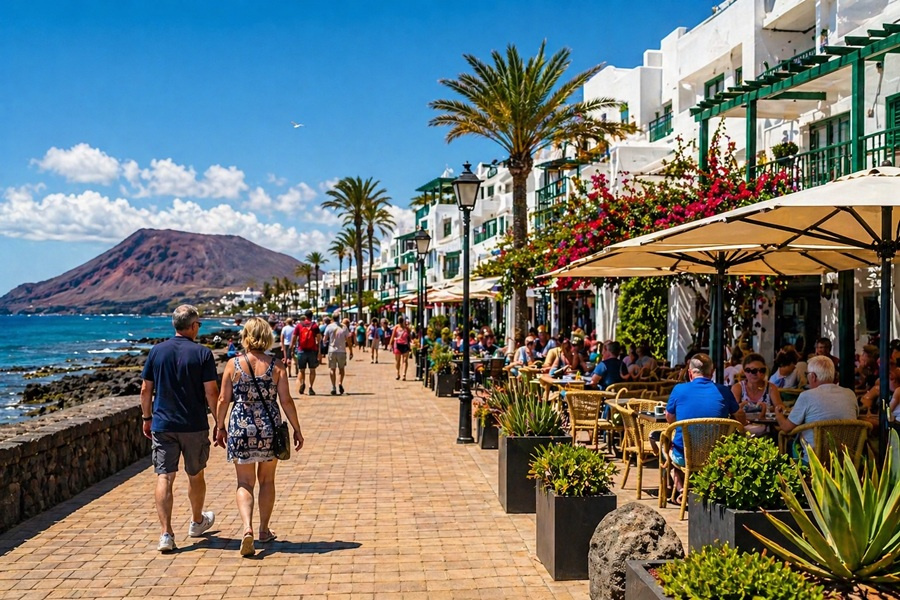
From Lanza Grotty to Lanza Poshy: Is Lanzarote Pricing Out Its Loyal Tourists?
Published 30 April 2026 at 09:19
By: Mr TravelON
Lanzarote prices are rising fast — from hotels to attractions. Are loyal British and Irish tourists being priced out as the island shifts toward higher-value tourism?
Standfirst: Accommodation prices in Lanzarote have climbed sharply, attraction costs have risen, and island leaders continue to talk about quality tourism and higher-value visitors. Mr TravelON asks whether Lanzarote is upgrading its offer — or risking the loyal British and Irish holidaymakers who helped turn the island into one of Europe’s most loved destinations.
Key points
- Lanzarote hotel rates reached an average of around €160.50 per night in March 2026, up 11.3% year-on-year, according to figures reported from the Lanzarote Data Centre.
- The rise has been driven heavily by lower-star accommodation, while some four and five-star hotels have reportedly reduced or frozen prices.
- Tourist attraction prices have also increased, with Timanfaya rising to €30 for adults and Jameos del Agua and Cueva de los Verdes at €17.
- Lanzarote welcomed a record 3.46 million visitors in 2025, with the UK and Ireland remaining two of the island’s most important markets.
- Mr TravelON warns that the island risks alienating its core audience if “wealthier tourism” is misunderstood as only targeting the super-rich.
What happened
Lanzarote is facing a growing debate over prices, identity and the future direction of tourism on the island.
For decades, Lanzarote has been loved by British and Irish holidaymakers for a simple but powerful combination: reliable sunshine, safety, cleanliness, friendly resorts, familiar hospitality and good value. But that balance is now being questioned as hotel prices, apartment rates, restaurant bills and attraction costs continue to rise.
Recent figures reported by La Voz de Lanzarote show the island’s average hotel rate reached €160.50 per night in March 2026, an 11.3% increase compared with the previous year. The same report said the rise was being driven particularly by three-star hotels and lower categories, while higher-category hotels were not necessarily seeing the same level of price growth. Source: La Voz de Lanzarote
For Mr TravelON, a travel expert with 30 years of experience working directly with tourists, this raises a serious question: has Lanzarote become too confident after the post-2020 tourism boom, and is the island now pricing itself out of the market that made it successful?
From “Lanza Grotty” to “Lanza Poshy”
The phrase “Lanza Grotty” has long followed Lanzarote around, often linked to comments made by Michael Palin in the 1980s. It became a nickname that stuck, even though many who know the island would argue it was never fair.
Lanzarote has changed dramatically since then. The island is cleaner, smarter, better connected and more internationally recognised than ever before. Resorts have improved, promenades have been upgraded, hotels have been modernised and the island has become one of the most dependable year-round destinations in Europe.
But Mr TravelON says the island now risks swinging too far the other way.
“Lanzarote has gone from being called Lanza Grotty to trying to become Lanza Poshy,” he says. “But Lanzarote has never been Monaco, Dubai or Ibiza. That is not what people come here for, and it is not what made this island successful.”
His concern is not that Lanzarote should avoid quality, investment or improvement. Quite the opposite. He believes the island should keep improving. But he argues there is a difference between raising standards and chasing an unrealistic image of luxury tourism that may not match the island’s infrastructure, flights, resorts or long-established visitor base.
Accommodation prices are changing the conversation
The latest accommodation data is central to the debate. A March average rate of more than €160 per night is a major figure for an island long associated with accessible package holidays, self-catering apartments and repeat family visitors.
La Voz de Lanzarote reported that the biggest price pressure came from lower-star hotels, while five-star hotels had actually reduced prices in March compared with the same period last year. A separate report said five-star hotel prices were down 2% year-on-year in March, while four-star hotels also showed reductions. Source: La Voz de Lanzarote
That is important because it suggests the price squeeze is not only happening at the luxury end. It is being felt in the type of accommodation many regular holidaymakers actually book: apartments, three-star hotels, lower-category hotels and family-friendly stays.
For visitors who have saved all year for a week or two in the sun, the issue is not just whether Lanzarote is still beautiful. It is whether the overall holiday still feels like value.
Flights, luggage, accommodation, transfers, food, drinks, excursions and attraction tickets all add up. When several of those costs rise at once, the feeling of affordability can disappear quickly.
Attraction prices have also risen
It is not only accommodation that has become more expensive. Lanzarote’s official tourist centres have also seen price increases.
Reports in late 2025 confirmed that entry to Montañas del Fuego at Timanfaya would rise to €30 for adults, with Jameos del Agua and Cueva de los Verdes at €17 each. The Cactus Garden and Mirador del Río were listed at €9, while Castillo de San José was set at €5.40. Source: Gazette Life
Cadena SER also reported concern from Lanzarote’s professional tourist guides, who warned that higher entrance fees could reduce excursion bookings and affect related sectors such as transport, restaurants and guiding services. Source: Cadena SER
Mr TravelON says this is exactly where the danger lies. Tourists may accept higher prices if they see clear improvements. But if the experience feels broadly the same while the bill is much higher, frustration grows.
“You cannot just keep putting prices up and expect people not to notice,” he says. “If you charge more, people expect more. Better organisation, better service, better value, fewer queues and a better overall experience.”
The “wealthier tourist” debate
One of the most controversial talking points in Lanzarote tourism has been the idea that the island should attract a more affluent or higher-spending visitor.
On paper, many destinations use similar language. They talk about quality tourism, sustainable tourism, higher spending, lower environmental pressure and better returns for the local economy. Lanzarote has also hosted and promoted major sustainable tourism discussions, including the ST+30 World Conference on Sustainable Tourism, held at Jameos del Agua in November 2025. Source: Biosphere Tourism
But Mr TravelON believes the language can easily be misunderstood — and can sound insulting to the people who already holiday on the island.
“What exactly do they mean by wealthy?” he asks. “Because the four and five-star hotels are full. Restaurants are full. People are spending money. Families who save all year to come here are wealthy in the way that matters to Lanzarote — they have disposable income and they spend it on the island.”
His argument is simple: wealth should not only mean private jets, designer beach clubs and luxury yachts. In Lanzarote’s case, wealth also means the working family from Manchester, Dublin, Cork, Liverpool, Glasgow or Belfast who has saved for months, arrives excited, books trips, eats out, buys drinks, takes taxis, visits attractions and supports small businesses.
That visitor may not be “super-rich”, but they are extremely valuable to Lanzarote.
British and Irish visitors remain the backbone of Lanzarote tourism
Lanzarote’s relationship with British and Irish tourists is not a side story. It is central to the island’s tourism economy.
Figures reported for 2025 show Lanzarote welcomed more than 3.46 million tourists, the highest figure in its history. The UK was by far the largest market, with more than 1.75 million visitors, while Ireland accounted for more than 385,000 visitors. Source: Gazette Life
Together, British and Irish visitors represent a huge share of Lanzarote’s tourism base. They are also among the most loyal. Many return year after year, often to the same resort, the same apartments, the same restaurants and the same bars.
Mr TravelON says this loyalty should not be taken for granted.
“Lanzarote has an amazing repeat audience,” he says. “People come back because they feel safe, they know what they are getting, they love the weather, they love the people and they feel comfortable here. But if those people start feeling unwanted or priced out, that is a dangerous game.”
Is Lanzarote really a luxury destination?
Mr TravelON argues that Lanzarote is a quality destination, but not a true luxury destination in the same category as Dubai, Monaco, St Barts or parts of Ibiza.
There are excellent hotels, premium villas, stylish restaurants and increasingly high-end venues. But the island does not have the same luxury ecosystem as global elite destinations. There are no regular first-class flight options into Lanzarote. The airport is heavily built around economy and short-haul European leisure travel. The resort offer remains mixed, with luxury hotels sitting alongside souvenir shops, casual bars, beach cafés, hair braiders, looky-looky sellers and family-focused entertainment.
For many visitors, that mixture is part of the charm.
Lanzarote is not loved because it is exclusive. It is loved because it is accessible, relaxed, familiar and easy. It is a place where visitors can dress up for a nice meal one night and walk the promenade in flip-flops the next.
Mr TravelON says trying to erase that identity would be a mistake.
“The mega-wealthy do not want tourist tat shops, looky-looky men and hair braiders outside their five-star experience,” he says. “But normal holidaymakers do not mind that. It is part and parcel of a holiday here. Lanzarote should improve, but it should not pretend to be something it is not.”
The Benidorm comparison — and why Lanzarote is different
Some people in tourism discussions use the phrase “Benidorm tourist” as shorthand for the type of visitor they do not want. Mr TravelON believes that comparison is unfair and lazy.
Lanzarote does not attract the same market as Benidorm in the first place. Its resorts are generally quieter, more spread out and more family or couple focused. Puerto del Carmen, Playa Blanca and Costa Teguise all have nightlife and entertainment, but they are not built around the same high-density party model.
At the same time, Mr TravelON says there is nothing wrong with ordinary working people wanting an affordable holiday.
“People who work hard all year and save for their holiday should not be looked down on,” he says. “They are the people who fill restaurants, book excursions, buy gifts, support bars and bring life to the resorts.”
His point is that Lanzarote already has a strong market. It does not need to chase a fantasy visitor at the expense of the real one.
What this means for travellers
For holidaymakers, the message is not that Lanzarote is no longer worth visiting. The island remains one of the safest, cleanest and most reliable sunshine destinations in Europe.
But travellers may need to plan more carefully than before. Accommodation prices can vary dramatically by resort, season and property type. Families who previously booked late deals may find fewer bargains. Visitors planning to see several attractions should budget properly in advance. Eating out remains good value in many places, but prime seafront locations and newer premium venues can be noticeably more expensive.
Mr TravelON says the best advice is to compare, book early where possible, and not assume Lanzarote is automatically the cheap option it may once have been.
“Lanzarote is still fantastic,” he says. “But people are noticing the prices. The island has to be careful because there are other destinations competing for the same tourist.”
Analysis: The danger of alienating the core audience
The biggest risk for Lanzarote is not that prices rise. Prices rise everywhere. The risk is that the island’s loyal visitors begin to feel that the value, welcome and identity of the destination are changing too quickly.
Tourism leaders often talk about wanting visitors who spend more. That makes sense from an economic point of view. But the mistake is assuming that higher spending only comes from richer people.
In reality, many ordinary holidaymakers spend heavily because the trip matters so much to them. It is their main holiday of the year. They arrive ready to enjoy themselves. They book the boat trip, the volcano tour, the nice meal, the cocktails, the taxis, the waterpark, the souvenirs and the family experiences.
By contrast, very wealthy and well-travelled visitors may spend more on accommodation but less across the wider resort economy. They may stay inside premium hotels, eat privately, chill by the pool and avoid the very businesses that depend on daily tourist footfall.
This is the point Mr TravelON believes Lanzarote must understand.
“A family that has saved all year comes here and spends,” he says. “They are excited. They want to do things. They want memories. That money goes into the island. Do not make those people feel like they are not good enough for Lanzarote.”
Mr TravelON’s view
Mr TravelON believes Lanzarote should continue to invest, improve and protect its environment. He supports better quality, better standards and a stronger tourism product. But he argues that improvement should not become arrogance.
The island’s success was built on loyalty, accessibility and trust. British and Irish tourists did not just discover Lanzarote after 2020. They helped build its tourism story over decades.
Now, after a post-pandemic boom and record visitor numbers, the island faces a choice. It can modernise while respecting the people who made it successful, or it can chase a luxury image that may not fit the reality on the ground.
“Lanzarote is not Dubai. It is not Monaco. It is Lanzarote,” Mr TravelON says. “That is why people love it. Make it better, yes. Make it cleaner, smarter and more sustainable, yes. But do not price out or talk down to the very people who have supported this island for years.”
Final word
The debate over “Lanza Grotty” to “Lanza Poshy” is really a debate about identity.
Lanzarote has grown up. It is no longer the cheap and rough-around-the-edges destination some people may remember from decades ago. It is more polished, more expensive and more confident.
But confidence can become complacency.
If prices keep rising without matching improvements, and if loyal visitors feel pushed aside in favour of a vague idea of “wealthier tourism”, Lanzarote could damage one of its greatest strengths: repeat visitors who love the island deeply and return year after year.
The question Mr TravelON asks is simple: is Lanzarote upgrading for the future, or forgetting who made it successful in the first place?
Plan Your Next Trip
Alongside the latest travel news from Mr TravelON, TravelON World helps holidaymakers find trusted travel services, destination information and experiences to plan their next trip with confidence.
About the author
Mr TravelON is the brand ambassador for TravelON and one of the most watched travel experts in the Canary Islands, with more than 400000 followers across YouTube, TikTok and Facebook. Mr TravelON has worked in tourism for over 25 years with tour operators, excursion suppliers and the local Canary Islands tourism board. He is on the ground in tourist destinations filming content, reviewing tours and talking with holidaymakers every day. His advice comes from real experience and direct contact with the island. As a Travel expert and editor he brings the most up to date travel news.