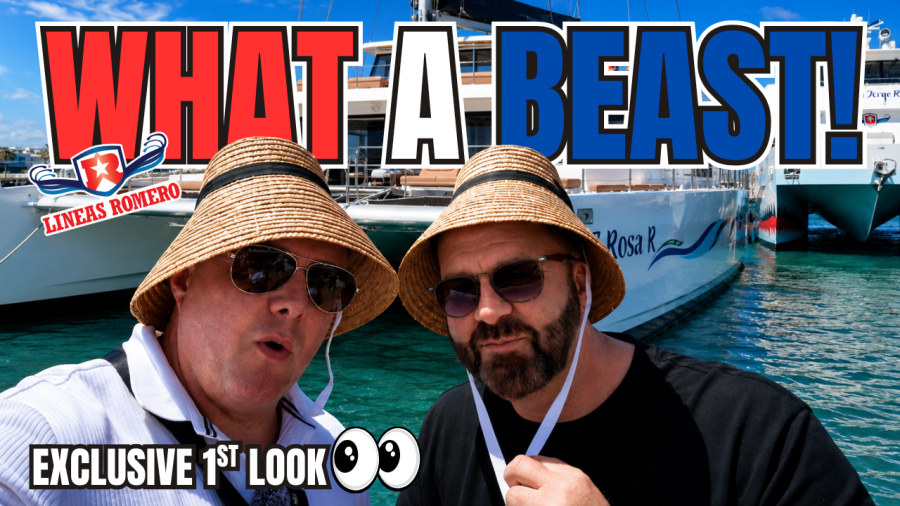
Líneas Romero has officially presented two brand-new vessels in Lanzarote: the purpose-built Rosa R super catamaran and the Juan Jorge R ferry, marking a major investment in inter-island transport, maritime tourism and the future of visitor experiences across the eastern Canary Islands.
What happened?
One of the most important maritime operators in the eastern Canary Islands has unveiled two major new vessels in Lanzarote, with Líneas Romero officially presenting the Rosa R super catamaran and the Juan Jorge R ferry.
The presentation took place at a special opening event in Lanzarote on 9 July 2026, bringing together representatives of the company, invited guests and members of the island’s business and tourism community.
Mr TravelON was there in person.
Rather than simply reporting from a press release or repeating publicity photographs, Mr TravelON attended the event and went onboard both vessels, filming an exclusive close-up look at what is one of the most significant recent private investments into Lanzarote’s maritime tourism and passenger transport sector.
The two vessels represent different but closely connected parts of the modern Líneas Romero operation.
The Juan Jorge R is a new ferry connected with the company’s important inter-island passenger services, including travel between Lanzarote and Fuerteventura.
The Rosa R, meanwhile, is a huge custom-built catamaran created for day-charter and excursion operations and has the potential to become one of the most recognisable new tourism experiences on the Lanzarote coastline.
For an island where the sea is central to tourism, transport, employment and everyday life, this is far more than the arrival of two new boats.
It is a major investment in Lanzarote.
Exclusive: Mr TravelON Goes Onboard the Rosa R and Juan Jorge R
TravelON World is bringing viewers directly inside the launch event, with Mr TravelON filming both vessels up close and going onboard for a detailed look around.
The exclusive video report shows the Rosa R and Juan Jorge R from the perspective that matters most to future passengers: what the vessels actually look and feel like when you step onboard.
Viewers can see the scale of the investment, the passenger areas and the very different roles the two vessels are expected to play within the wider Líneas Romero operation.
This first-hand access is important because these are not concepts, computer designs or vessels promised for some distant future date.
They are here.
They have been officially presented in Lanzarote.
And Mr TravelON was at the event to show both of them.
The Rosa R: A Brand-New Custom-Built Super Catamaran
Of the two new vessels, the Rosa R is likely to attract immediate attention from holidaymakers because this is no ordinary addition to Lanzarote’s excursion market.
This is a vast, purpose-built day-charter catamaran created specifically around the requirements of large-scale passenger experiences at sea.
Builder information associated with the project describes the catamaran as the largest vessel of its type produced by DAY 1 Catamarans to date, underlining the scale of the project.
Published headline specifications associated with the vessel include:
- Length: nearly 27 metres, or around 90 feet
- Width: approximately 12.9 metres
- Passenger capacity: up to 250 passengers
- Main deck area: approximately 190 square metres
- Additional flybridge area: approximately 60 square metres
- Purpose: large-scale day-charter and excursion operations
Those numbers are impressive on paper, but the true scale of the Rosa R becomes far more obvious when the vessel is seen up close.
Mr TravelON’s exclusive onboard footage gives travellers a first look at a catamaran that could become a major new feature of Lanzarote’s excursion industry.
This matters because Lanzarote already has one of the most established maritime excursion markets in the Canary Islands.
Holidaymakers can currently choose from trips to La Graciosa, Papagayo cruises, dolphin and wildlife experiences, sunset sailings, catamaran excursions, waterbus services and inter-island journeys.
The arrival of a brand-new custom-built vessel on the scale of the Rosa R creates the potential for something significantly different.
Could the Rosa R Become One of Lanzarote’s Biggest New Excursions?
Local launch information has linked the new catamaran with future experiences around Papagayo and the Lanzarote coastline, including the potential for sunset-based sailings.
That immediately makes the Rosa R highly relevant to holidaymakers.
Papagayo is one of the most famous areas of Lanzarote, known for its beaches, protected landscape and striking coastline in the south of the island.
It is already reached in several different ways. Visitors drive into Los Ajaches, walk sections of the coastline or experience Papagayo from the sea on existing boat excursions.
A purpose-built catamaran capable of carrying up to 250 passengers could create an entirely new scale of experience.
The key, of course, will be the final excursion format.
Passenger capacity alone does not make a great day out. Service, atmosphere, food and drink, swimming stops, onboard entertainment, route planning, comfort and the quality of the crew will all matter.
But after seeing the vessel personally at the official opening event, Mr TravelON believes the potential is enormous.
The Rosa R is the kind of vessel that could become an attraction in its own right rather than simply the transport used to reach somewhere else.
TravelON World has previously reported on visitor access and pressure around the wider Papagayo and Los Ajaches area.
Read more: Papagayo access fees and visitor pressure in Los Ajaches
The Juan Jorge R: A Major New Ferry Investment
Alongside the Rosa R, Líneas Romero has also unveiled the brand-new Juan Jorge R.
The new ferry represents further investment in inter-island passenger transport and is set to strengthen the company’s operations connecting Lanzarote and Fuerteventura.
Líneas Romero is already a familiar name to travellers using the short sea connection between Playa Blanca in southern Lanzarote and Corralejo in northern Fuerteventura.
For tourists, this is one of the most practical island-hopping routes in the Canary Islands.
Holidaymakers staying in Lanzarote can cross to Fuerteventura without taking another flight, while visitors based in Fuerteventura can travel in the opposite direction to Playa Blanca and explore Lanzarote.
The route is used by independent travellers, organised excursion customers, residents and visitors simply looking to experience two islands during one holiday.
The arrival of the Juan Jorge R therefore matters beyond the company itself.
It represents continued private investment in an important piece of eastern Canary Islands transport infrastructure.
Mr TravelON was able to step onboard during the official presentation, giving viewers a close-up tour of the new vessel and documenting this latest stage in the development of the Líneas Romero fleet.
Why the Lanzarote to Fuerteventura Ferry Market Matters
The launch of the Juan Jorge R comes at a particularly interesting time for ferry travel in the Canary Islands.
The wider market has been changing rapidly, with new branding, fleet investment and major corporate developments affecting routes across the archipelago.
TravelON World recently reported on the arrival of Baleària Canarias following major changes involving former Armas ferry operations.
That story is directly relevant because the Playa Blanca to Corralejo corridor is one of the routes where different ferry operators compete for passengers travelling between Lanzarote and Fuerteventura.
Against that changing background, continued investment from Líneas Romero is significant.
This is a company with deep local roots that is not standing still while the wider ferry market changes around it.
What we know about the wider fleet investment
The presentation of the Rosa R and Juan Jorge R should not be viewed as an isolated purchase.
Local reporting from the launch highlighted the scale of the wider fleet-renewal programme taking place within Líneas Romero.
Federico Romero said that more than 85% of the company’s fleet has been renewed, with that proportion of vessels having an age of approximately two to eight years.
For a maritime business whose history stretches back to 1930, that is an important point.
The company may have deep historic roots, but the modern operation is investing heavily in newer vessels and a new generation of passenger experiences.
The Rosa R and Juan Jorge R are therefore part of a much wider story of modernisation.
The History of Líneas Romero: From a Rowing Boat to a Modern Maritime Fleet
To understand why the launch of these vessels matters so much in Lanzarote, it is necessary to go back almost a century.
Líneas Romero is not simply a tourism company that arrived in the Canary Islands after the development of mass holidays.
Its story begins long before Lanzarote became the international tourism destination we know today.
1930: The story begins between Lanzarote and La Graciosa
According to the company’s own official history, the story began in 1930 when Jorge M. Toledo established what became the first maritime postal operation connecting La Graciosa and Lanzarote.
The beginnings could hardly have been more different from the Rosa R and Juan Jorge R being presented in 2026.
The early service used a simple rowing boat to carry mail between the islands.
Today, that may sound almost impossible to imagine.
But for the small community of La Graciosa, maritime connections were fundamental. The sea was not a tourism experience. It was the route to communication, supplies, family connections and the outside world.
The postal business later passed to Jorge M. Toledo’s daughter, Juana González Toledo, who married Juan Romero.
1970: Juan Romero expands the operation
In 1970, Juan Romero took charge of the company and expanded the services being offered.
This was an important stage in the development of the business.
Lanzarote itself was changing. Tourism was beginning to transform the island, transport requirements were evolving and the relationship between the eastern Canary Islands was entering a very different era.
1985: The next generation takes over
In 1985, the business passed to the four children of the family:
- Luis Romero
- Juan Jorge Romero
- Federico Romero
- Rosa Romero
Under the following generation, the business continued to expand and modernise while maintaining its close relationship with La Graciosa.
That family history also gives extra meaning to the names carried by vessels across the modern fleet.
The latest additions, Rosa R and Juan Jorge R, continue a strong connection between family identity, maritime tradition and the modern company.
From Essential Island Transport to Tourism Experiences
The modern Líneas Romero operation now works across two areas that are different but closely connected.
Regular maritime transport
The company operates passenger connections across the eastern Canary Islands, with regular services involving Lanzarote, La Graciosa and Fuerteventura.
These routes are important not only to tourists but also to island connectivity.
The company’s official services include the ferry connection between Lanzarote and La Graciosa and the ferry route between Lanzarote and Fuerteventura.
Waterbus services in Lanzarote
Líneas Romero also operates waterbus connections in Lanzarote, including services linking areas such as Puerto Calero and Puerto del Carmen.
These services give visitors another way to experience the island’s coastline while travelling between important tourism locations.
Catamaran excursions and tourism experiences
The company has also developed a major excursion operation.
This side of the business is particularly familiar to holidaymakers, with maritime experiences involving destinations such as La Graciosa, Papagayo and the waters around Lanzarote and Fuerteventura.
That combination helps explain why presenting a new ferry and a huge custom-built excursion catamaran at the same event is so significant.
The two new vessels represent both sides of the modern company.
The Juan Jorge R is connected with moving people between islands.
The Rosa R is connected with what people do once they come here on holiday: explore, experience the sea and discover the coastline.
Why La Graciosa Remains at the Heart of the Líneas Romero Story
Despite the scale of the modern operation, La Graciosa remains fundamental to the identity of Líneas Romero.
The company’s own history makes clear that its roots are tied directly to the island and the first maritime postal connection with Lanzarote.
This matters because La Graciosa itself has changed dramatically.
What was once a highly isolated island community has become one of the most popular visitor experiences in the Canary Islands.
TravelON World previously reported that La Graciosa had exceeded 600,000 visitors over a 12-month period, highlighting the extraordinary scale of tourism pressure on an island with a small resident population and limited infrastructure.
That growth creates both opportunity and difficult questions.
Maritime transport is essential to the island, but visitor numbers also create pressure involving waste, water, energy, services and the protection of a highly sensitive environment.
This is why the history of Líneas Romero cannot be separated from the wider future of La Graciosa.
Read more: La Graciosa exceeds 600,000 visitors over a 12-month period
What Is the Fundación Líneas Romero?
Another major part of the wider story is the Fundación Líneas Romero.
The Foundation gives formal structure to social, community, educational and environmental work connected with the wider organisation.
According to the Foundation’s own published information, its aim is to contribute towards a society that is more equitable, inclusive and sustainable.
Its work is organised around three principal areas:
- Health and community
- Innovation and human capital
- Environmental sustainability
This is an important part of the Líneas Romero story because the wider organisation is not presenting growth only in terms of passenger numbers, new routes or the size of its vessels.
The Foundation is involved in projects connected to health, serious illness, family support, education, Canarian talent, traditional sport and sustainability.
Project AVANTE: Support Beyond Cancer Treatment
One of the Foundation’s significant initiatives is Project AVANTE.
The project focuses on creating social connections and shared spaces for cancer patients, relatives and carers.
The idea is that serious illness should not be viewed only through the medical treatment itself.
Emotional wellbeing, human connection, activity and the ability to continue participating in life also matter.
Through AVANTE, the Foundation promotes activities intended to help patients and those around them remain active, connected and supported through different stages of the process.
In 2026, the Foundation published information about the second edition of the initiative alongside the Cabildo de Lanzarote and the Canary Islands Health Service.
Project DESCANSA: Giving Families Space to Breathe
Another important programme is DESCANSA.
Developed in collaboration with the Asociación Kilómetros por Sonrisas, the project offers families with children affected by cancer or rare diseases the possibility of spending several days resting and disconnecting in La Graciosa.
The thinking behind the project is particularly powerful.
When a child faces serious illness, the impact is rarely limited to the patient alone.
Parents, siblings and the wider family can all experience enormous emotional and practical pressure.
DESCANSA recognises the importance of giving the family unit a chance to pause, reconnect and experience time away from the constant demands surrounding illness and treatment.
Supporting Casa Pipa and Families Travelling for Treatment
Fundación Líneas Romero also supports Casa Pipa, an initiative associated with the Fundación Canaria Pequeño Valiente.
The project provides temporary accommodation for families from non-capital islands whose children need oncohaematological treatment in Gran Canaria.
This addresses a very real challenge of island life.
A family living in Lanzarote, Fuerteventura, La Graciosa or another non-capital island may face not only the trauma of a child requiring serious medical treatment but also the practical upheaval of travelling and staying away from home for prolonged periods.
Casa Pipa is designed to reduce some of that pressure by helping provide a place to stay during extremely difficult circumstances.
Supporting Canarian Talent and Sustainable Innovation
The Foundation’s work extends beyond health and community support.
Through its Innovation and Human Capital programme, it also focuses on education, opportunity, local talent and socially responsible innovation.
Premios Talento Sostenible
The Talento Sostenible awards are designed to recognise and support viable ideas that combine talent, creativity, innovation and sustainability.
This creates a platform for projects looking for practical solutions to social or environmental challenges.
Becas Mercedes Medina
The Foundation also works with the Asociación Mercedes Medina to support Canarian talent through university scholarships for young people.
That focus on education matters because long-term island development depends on more than tourism numbers.
It also depends on whether young people can access education, develop skills, create businesses and build futures within the Canary Islands.
What This Means for Travellers
For most holidaymakers, the practical question is straightforward:
What difference could the Rosa R and Juan Jorge R actually make to a holiday?
More investment in Lanzarote to Fuerteventura travel
The Juan Jorge R represents continued investment in inter-island passenger travel.
For visitors staying in places such as Playa Blanca, Puerto del Carmen, Costa Teguise, Corralejo or elsewhere across Lanzarote and Fuerteventura, ferry connections create the possibility of experiencing another island without taking a flight.
A potentially major new Papagayo excursion
The Rosa R could become the more visible change for excursion customers.
Its scale, custom-built design and large passenger areas create the possibility of a very different type of maritime experience around the Lanzarote coastline.
More choice in a competitive excursion market
Lanzarote already has a strong boat excursion industry.
New investment raises expectations across the market.
Travellers increasingly look beyond simply asking whether an excursion is available. They compare comfort, space, food, service, route, value for money and the overall experience.
A major new vessel can push the wider market forward.
Analysis: Why This Is Bigger Than Two New Boats
The following section is analysis from Mr TravelON.
It would be very easy to report this story as a ferry company launching two boats and leave it there.
In Mr TravelON’s view, that completely misses the bigger story.
Lanzarote has spent much of the last two years appearing in headlines about overtourism, protests, holiday rentals, housing pressure, rising prices and arguments about the future direction of tourism.
Those debates are real.
They should be reported.
But they are not the entire story of Lanzarote.
There is another side to what is happening on the island: established businesses continuing to invest, employ people, renew infrastructure and create products designed for the future.
The unveiling of the Rosa R and Juan Jorge R is a clear example.
One vessel strengthens practical inter-island transport.
The other has the potential to create a major new tourism experience around one of Lanzarote’s greatest assets: the sea.
This is also not an outside company with no historic connection to the destination suddenly arriving to exploit a tourism boom.
Líneas Romero traces its story back to 1930 and a rowing boat carrying the post between Lanzarote and La Graciosa.
Nearly a century later, the company is unveiling a purpose-built catamaran almost 27 metres long with capacity for up to 250 passengers alongside another brand-new ferry.
Just stop and consider that journey.
From a rowing boat carrying mail to the Rosa R.
That is an extraordinary transformation.
Mr TravelON: “This Is Investment Into Lanzarote”
Mr TravelON believes the launch deserves attention because the tourism debate in the Canary Islands needs balance.
Tourism cannot simply be discussed as one headline visitor number.
The real questions are far more complicated.
Who invests?
Who employs local people?
What infrastructure is being improved?
What experience are visitors receiving?
How much pressure is being placed on communities?
What is being returned to those communities?
How is the environment being protected?
Two new vessels do not solve every challenge facing Lanzarote.
Of course they do not.
But the Rosa R and Juan Jorge R do represent confidence, modernisation and a willingness to put serious investment into the future of maritime tourism and passenger travel.
At a time when so many headlines make holidaymakers believe Lanzarote is permanently in crisis, stories like this also deserve to be told.
TravelON World has repeatedly examined the gap between dramatic international headlines and what is actually happening on the ground in Lanzarote.
Related Truth Travel report: Lanzarote “Tourists Go Home” protests explained
Mr TravelON’s Verdict
Having attended the official opening event and toured both vessels personally, Mr TravelON believes this is a major moment for Líneas Romero and an important investment into Lanzarote.
The Juan Jorge R represents continued confidence in inter-island passenger travel and the important maritime connection between Lanzarote and Fuerteventura.
The Rosa R, meanwhile, has the potential to become one of Lanzarote’s standout excursion experiences once its full programme begins.
Seeing the Rosa R in person makes the sheer scale of the vessel difficult to ignore.
But perhaps the most powerful part of the story is what stands behind both new vessels.
A maritime business whose history began in 1930 with a rowing boat carrying mail between La Graciosa and Lanzarote is now launching a new generation of custom-built vessels.
The names of the latest two additions are:
Rosa R.
Juan Jorge R.
Two brand-new vessels.
A major investment.
And another extraordinary chapter in a Canary Islands maritime story approaching a century at sea.
Sources and further information
This report combines Mr TravelON’s first-hand attendance at the official launch event with information published by Líneas Romero, Fundación Líneas Romero, builder material associated with the Rosa R project and current local reporting.
- Líneas Romero – Official company history
- Líneas Romero – Official routes and services
- Fundación Líneas Romero – Official website
- Fundación Líneas Romero – Health and community programmes
- Fundación Líneas Romero – Innovation and human capital programmes
- Lancelot Digital – Local coverage of the 2026 vessel presentation