
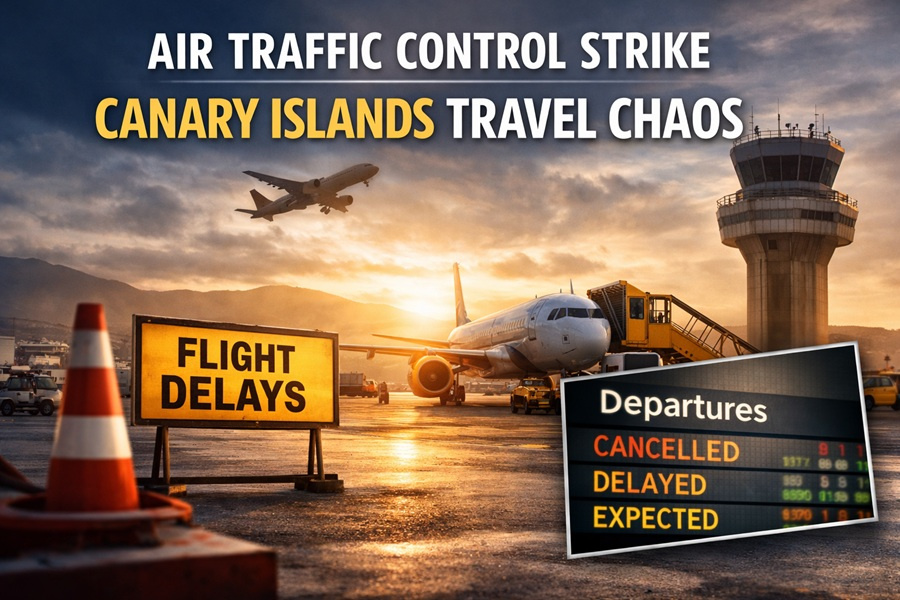
Spain air traffic control strike from 17 April: Lanzarote and Fuerteventura flights face disruption
Published 14 April 2026 at 21:47
By: Mr TravelON
An indefinite air traffic control strike is due to begin in Spain on 17 April, affecting 14 Saerco-managed airport towers including Lanzarote and Fuerteventura. Travellers should prepare for delays, schedule changes and knock-on disruption rather than assuming airports will fully shut down.
Standfirst: An indefinite air traffic control strike is due to begin in Spain on 17 April, affecting 14 Saerco-managed airport towers including Lanzarote and Fuerteventura. For travellers heading to the Canary Islands, the biggest risks are delays, schedule changes and missed onward connections rather than a total shutdown of flights.
Travellers flying to Spain and the Canary Islands this Easter week are being warned to prepare for disruption as an indefinite air traffic control strike is set to start at midnight on Friday 17 April.
The action has been called by the unions USCA and CCOO and affects air traffic controllers working in towers managed by private provider Saerco. Among the airports in the firing line are Lanzarote and Fuerteventura, two of the most important gateways for holiday traffic to the Canary Islands.
While the strike does not mean every flight will be cancelled, it does raise the risk of delays, knock-on disruption, schedule reshuffles and pressure on busy travel days. For passengers heading to the islands, especially those travelling on package holidays, short breaks or tight connections, that uncertainty is likely to be the biggest issue.
What we know
- An indefinite strike is scheduled to begin at 00:00 on 17 April.
- The dispute affects 14 Saerco-managed airport towers across Spain.
- Canary Islands airports affected include Lanzarote, Fuerteventura, La Palma, El Hierro and La Gomera.
- The unions say the dispute is driven by staff shortages, workload pressure, shift changes and concerns about operational fatigue.
- Travellers should expect the greatest risk to be delays, late aircraft rotations, missed connections and short-notice timetable changes.
- Minimum service rules are expected to keep part of the operation running, so this is not the same as a full closure of the affected airports.
What happened
The strike notice was filed by the Unión Sindical de Controladores Aéreos (USCA) and Comisiones Obreras (CCOO), who say conditions inside Saerco-managed towers have become unsustainable.
According to the unions, the dispute is not about a single rota issue or a temporary disagreement. They describe it as a structural problem linked to reduced staffing, increasing workload, cancelled leave, short-notice shift changes and pressure on legally required rest periods. Their argument is that these conditions are not only affecting workers, but could also have consequences for the resilience of operations at smaller but strategically important airports.
That matters in the Canary Islands, where air connectivity is not optional. On islands such as Lanzarote and Fuerteventura, aviation is the essential link for tourism, business travel, family movement and onward international connections.
Which airports are affected?
The strike affects 14 Saerco-managed towers in Spain. These are reported to include Madrid-Cuatro Vientos, Lanzarote, Fuerteventura, La Palma, El Hierro, La Gomera, Castellón, Burgos, Huesca, Ciudad Real, Vigo, A Coruña, Jerez and Sevilla.
For TravelON World readers, the biggest focus is naturally on the Canary Islands. The airports most relevant to island travellers in this dispute are:
- Lanzarote
- Fuerteventura
- La Palma
- El Hierro
- La Gomera
Lanzarote and Fuerteventura stand out because of the high volume of UK and European leisure traffic they handle, especially around school holiday and Easter travel periods. Any slowdown there can quickly ripple into check-in halls, gate areas, crew duty times and aircraft positioning for later flights.
What this means for Lanzarote and Fuerteventura travellers
For most holidaymakers, the most likely impact is not a dramatic airport shutdown. It is a more familiar but still frustrating pattern: aircraft departing late from earlier sectors, inbound flights being held, departure slots shifting, turnaround times tightening and passengers spending longer waiting for clear information.
At airports such as Lanzarote and Fuerteventura, that can hit particularly hard on busy changeover days when several flights arrive and depart in close succession. Once one rotation slips, the rest of the day can start to move with it.
Travellers should also remember that disruption may begin before they even reach the islands. If your aircraft is operating into or out of another affected airport earlier in the day, that delay can carry forward onto your Lanzarote or Fuerteventura flight even if your own airport looks calm at first glance.
In practical terms, passengers should prepare for:
- Departure delays
- Late gate announcements or gate changes
- Schedule amendments at short notice
- Longer waits for aircraft to be cleared
- Missed onward connections, especially on self-transfer itineraries
- Possible cancellations on weaker rotations if disruption builds through the day
Will flights be cancelled?
Some may be, but widespread blanket cancellation is not the most likely opening scenario.
Because air traffic control is an essential service, the Spanish authorities can impose minimum service levels. That usually means a portion of flights continue to operate, even during industrial action. The result for travellers is often a patchwork day: some flights operate close to time, some are delayed significantly, and some are cancelled where airlines decide the knock-on impact has become too severe.
That is why passengers should think less in terms of “will my airport close?” and more in terms of “how much resilience is built into my journey?” Direct flights are safer than tight connections. Morning departures can sometimes fare better than later rotations, though that is never guaranteed. Self-connecting itineraries carry the greatest risk.
What travellers should do now
If you are flying to or from Lanzarote, Fuerteventura or any of the affected Spanish airports from 17 April onwards, the smartest move is to travel as if your itinerary could change at short notice.
Before you leave for the airport
- Check your airline app, booking email and SMS alerts repeatedly, not just once.
- Look at the inbound aircraft if your airline app shows it, because a late incoming plane is often the first sign of delay.
- Keep screenshots of your original booking, any schedule changes and all airline messages.
- Do online check-in as early as possible.
- Pack essentials, medication, chargers and travel documents in cabin baggage.
At the airport
- Arrive with sensible extra time, especially if you are checking luggage.
- Do not rely on one display board only. Watch airline notifications and airport screens together.
- Avoid leaving the gate area too casually if your flight is delayed, because timings can move again.
- If you are on a package holiday, keep your tour operator details ready as well as the airline contact channel.
If your flight is delayed or cancelled
- Ask the airline for re-routing options, not just a refund, if you still need to travel.
- Keep receipts for food, transport or accommodation if the airline instructs you to arrange essentials yourself.
- Request written confirmation of the cause of disruption.
- Do not assume compensation is automatic just because the delay is long.
Your rights if you are affected
Under EU passenger rights rules, travellers affected by delays or cancellations can still be entitled to care and assistance, even when the disruption is linked to extraordinary circumstances such as external air traffic control strikes.
That usually means the airline still has responsibilities around re-routing or reimbursement, plus meals, refreshments, and where necessary accommodation during long waits. However, financial compensation under EU261 is often more difficult where the disruption is caused by an external ATC strike rather than something within the airline’s own control.
In simple terms: you may not automatically get compensation, but you should still expect support, rebooking options and information from the airline.
Why this matters so much in the Canary Islands
The Canary Islands are more exposed to aviation disruption than most mainland destinations because there is no realistic alternative to flying for the vast majority of international visitors.
For Lanzarote and Fuerteventura in particular, Easter and spring are not fringe travel periods. They are core weeks for inbound tourism, accommodation occupancy, airport throughput and local business activity. Even moderate disruption can affect hotel arrivals, car hire collection times, transfers, excursion bookings and return travel for thousands of holidaymakers.
It is also another reminder that Canary Islands travel in 2026 is being shaped by more than one pressure point at a time. Weather disruption, airport process changes, operational staffing pressure and wider European aviation bottlenecks are all part of the same story for travellers this year.
Analysis
This is exactly the kind of strike that can look smaller on paper than it feels in real life.
These are not Spain’s biggest hub towers, and that may lead some travellers to underestimate the risk. But for island routes and regional leisure airports, smaller control towers play an outsized role. A delay at the wrong point in the aircraft rotation can hit the rest of the day. That is particularly relevant in Lanzarote and Fuerteventura, where many passengers are leisure travellers on fixed accommodation dates and where flights often operate in tightly stacked arrival and departure waves.
The key message is not panic. It is preparation. Most passengers will probably still travel. But many may do so later than planned, with less certainty than they expected.
TravelON World advice
If you are flying during the strike period, treat your departure time as live until the aircraft is airborne. Keep checking for updates, build in flexibility, and avoid making the day more fragile than it needs to be.
For Lanzarote and Fuerteventura passengers, direct flights remain the safest option. If you are still due to travel, the best defence is simple: monitor your booking closely, carry essentials with you, document everything, and be ready for delay rather than assuming cancellation.
TravelON World will continue to watch for any late agreement, service minimum update or operational change before the 17 April start date.
Plan Your Next Trip
Alongside the latest travel news from Mr TravelON, TravelON World helps holidaymakers find trusted travel services, destination information and experiences to plan their next trip with confidence.
About the author
Mr TravelON is the brand ambassador for TravelON and one of the most watched travel experts in the Canary Islands, with more than 400000 followers across YouTube, TikTok and Facebook. Mr TravelON has worked in tourism for over 25 years with tour operators, excursion suppliers and the local Canary Islands tourism board. He is on the ground in tourist destinations filming content, reviewing tours and talking with holidaymakers every day. His advice comes from real experience and direct contact with the island. As a Travel expert and editor he brings the most up to date travel news.