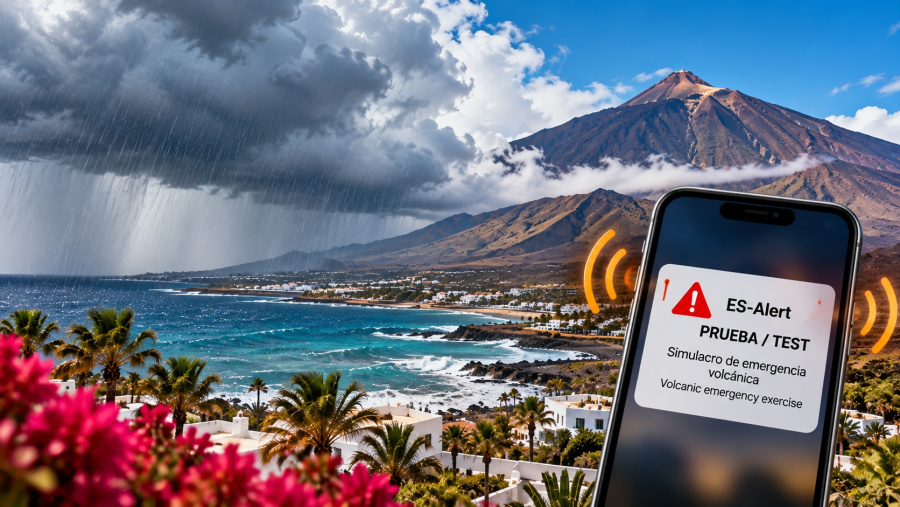
Heavy rain and possible thunderstorms have prompted a Canary Islands-wide pre-alert on Wednesday 21 October 2026, while Tenerife prepares to send emergency mobile-phone warnings during a planned volcanic exercise on Thursday 22 October. Mr TravelON explains the real weather risk, the simulated volcano alert and what holidaymakers should do.
Watch: Mr TravelON on the Canary Islands weather alert and Tenerife volcano drill
In this video report, Mr TravelON examines the DANA-related rainfall warnings affecting the Canary Islands and explains why residents and tourists may receive volcanic emergency alerts on their phones on 22 October. The rain warnings are real; the volcanic alert is a test.
Watch the full Canary Islands weather and volcano drill report
What happened in the Canary Islands on 21 October?
The Canary Islands entered Wednesday 21 October 2026 with unsettled weather and two very different emergency-related stories making headlines ahead of the UK October half-term holiday period.
First, the Canary Islands Government confirmed a rain pre-alert across the whole autonomous community from 07:30. The notice describes an incoming mass of moist, unstable air, with showers distributed unevenly and some becoming locally strong or accompanied by thunderstorms.
Separately, authorities have announced a planned volcano emergency simulation in Tenerife for Thursday 22 October. The mobile alerts associated with the exercise are genuine test messages, but the volcanic scenario described within them is fictional.
These are not two warnings about the same emergency. One concerns actual weather conditions; the other is a planned exercise designed to test emergency response arrangements and the public warning system.
Canary Islands DANA weather: why Lanzarote is on yellow alert
The unsettled conditions are being linked to a DANA, Spain's term for an isolated upper-level low-pressure system, known in Spanish as Depresión Aislada en Niveles Altos.
This type of weather system can create atmospheric instability, heavy showers and thunderstorms. The expression "Storm Dana" can be misleading because DANA describes a weather pattern rather than the official name of a particular storm.
For Lanzarote and La Graciosa, a yellow AEMET rain warning on 21 October highlights the potential for roughly 15 millimetres of rain in one hour. Heavy showers can be highly localised: one resort may experience an intense downpour while a nearby town sees lighter rain or a dry interval.
The published yellow-warning period for Lanzarote was scheduled to end at 18:00 local time when this report was prepared. Warning periods can be revised, so travellers should check the latest official forecast rather than relying on an earlier update.
The Government's wider rain pre-alert also identifies the potential for up to 60 millimetres over 12 hours in affected places. This is a forecast possibility and hazard threshold, not a measurement of rain already recorded across every island.
Which Canary Islands are affected by the rain alert?
The Government pre-alert includes all eight main islands and island groups: Lanzarote, La Graciosa, Fuerteventura, Gran Canaria, Tenerife, La Palma, La Gomera and El Hierro.
However, an archipelago-wide pre-alert does not mean every island has the same AEMET warning colour or will experience identical rainfall. Conditions can vary considerably between islands, resorts and inland areas.
Lanzarote and La Graciosa
Lanzarote and La Graciosa have a specific yellow rain warning for potentially heavy showers, with rainfall of around 15 mm in one hour possible. Visitors in Playa Blanca, Puerto del Carmen and Costa Teguise should monitor local conditions and be prepared for changes to outdoor activities.
Fuerteventura
Fuerteventura is included in the regional Government pre-alert. Holidaymakers in Corralejo, Caleta de Fuste, Costa Calma and Jandía should check the local forecast rather than assume that conditions will match those in neighbouring Lanzarote.
Gran Canaria
Gran Canaria is also covered by the pre-alert. Visitors in Maspalomas, Playa del Inglés and Puerto Rico should follow local weather updates, particularly when planning excursions, coastal activities or journeys away from resort areas.
Tenerife
Tenerife is included in the rain pre-alert and is also preparing for the planned volcanic emergency exercise on Thursday. Visitors staying in Costa Adeje, Los Cristianos and Playa de las Américas should distinguish between any genuine weather warnings and the separately announced ES-Alert test.
La Palma, La Gomera and El Hierro
These western islands are included in the Government's archipelago-wide rain pre-alert. Travellers should consult the forecast for their specific destination because the timing, intensity and location of showers may differ.
Is Lanzarote closed? Are flights and excursions cancelled?
A yellow weather warning is not a holiday cancellation notice. It indicates a weather hazard that should be taken seriously, but it does not automatically mean that an island, airport or tourist resort is closed.
At the time this report was prepared, the available information did not establish an archipelago-wide airport shutdown or blanket cancellation of flights and excursions because of the rain pre-alert.
Individual airlines, excursion operators and transport providers may still change schedules if local conditions make an activity unsafe. Boat trips, hiking excursions, Timanfaya tours, mountain-road journeys and exposed coastal activities may be particularly sensitive to changing weather conditions.
If you are travelling on 21 or 22 October, check your airline and Aena airport information before leaving for the airport. Contact your excursion provider directly if you have a booking and need confirmation that the activity is going ahead.
Avoid driving or walking through floodwater, and stay clear of barrancos and drainage channels during intense rain. Even when a road appears passable, water levels can rise quickly during heavy showers.
Tenerife volcano alert on 22 October: what is actually happening?
On Thursday 22 October 2026, Tenerife will host VOLCANEX Tenerife 2026, a volcanic risk exercise organised by the Cabildo de Tenerife.
As part of the exercise, 112 Canarias will test the ES-Alert public warning system, which sends audible and vibrating emergency messages directly to compatible mobile phones within a defined coverage area.
According to the official announcement referenced in this report, three messages are planned between 09:00 and 14:00 Canary Islands time. Authorities have not published a guaranteed exact minute for each individual message.
The exercise is designed to test emergency communications and response procedures. The simulated volcanic scenario should not be confused with an announcement that Mount Teide is erupting or that a real volcanic emergency has begun.
What will the three Tenerife phone alerts say?
First message: simulated orange volcanic alert
The first message will simulate a change to orange volcanic alert status for Tenerife. This is part of the exercise and does not indicate that an eruption has started. It does not, by itself, instruct the public to evacuate or take shelter.
Second message: simulated preventive evacuation
The second message will simulate a preventive evacuation of Chirche and Aripe, targeting the Guía de Isora and Santiago del Teide area.
People elsewhere who receive the message are not automatically included in the evacuation scenario. The exercise is intended to test how warnings are distributed and how the relevant emergency arrangements operate.
Third message: exercise completed
The third message will confirm that the exercise has ended.
The first alert is intended for Tenerife, but mobile-network coverage may carry it into parts of Gran Canaria, La Palma, La Gomera, El Hierro and surrounding sea channels. Some later messages may also reach neighbouring areas.
Receiving a test alert outside the main target area does not mean a real disaster is occurring in that location.
What should tourists do if their phone sounds an emergency alarm?
Compatible phones may emit a loud warning sound and vibrate even when the handset is normally set to silent. This can be startling for visitors who are unaware of the planned exercise.
During the announced exercise, look for the word PRUEBA, which means "TEST" in Spanish. An English version may appear on phones configured in another language.
- Read the alert carefully and check whether it is clearly marked as a test.
- Acknowledge the test message and follow the instructions provided for the exercise.
- Do not call 112 simply because you have received the scheduled test alert.
- If you are driving, stop somewhere safe before reading the message on your phone.
- Continue to take any separate, genuine emergency warning seriously.
A scheduled test is not a reason to ignore future real warnings. If an alert is not clearly identified as a test or gives genuine emergency instructions, consult official information and follow the relevant directions.
Does Tenerife have an active volcano — and why not Lanzarote?
Tenerife has an active volcanic system. Mount Teide and the wider island are monitored by Spain's Instituto Geográfico Nacional (IGN).
Tenerife's last historical eruption took place at Chinyero in November 1909, not at Teide's summit. An active volcano is one that may erupt again on geological timescales; the term does not, by itself, mean that an eruption is imminent.
Lanzarote is volcanic too, and its most recent historical eruptions occurred in 1824. Tenerife has been selected for this particular Cabildo-organised exercise because it is testing the island's volcanic emergency plans and a simulated scenario around Guía de Isora.
Other islands have participated in earlier ES-Alert tests. The choice of Tenerife for this exercise is not proof that the island faces an immediate volcanic crisis.
The IGN's volcanic monitoring updates provide scientific context for understanding activity beneath the islands. In June 2026, the IGN reported low-frequency seismic activity beneath Tenerife while stating that those observations did not increase short- or medium-term eruption danger at that time.
That earlier scientific assessment should not be mistaken for a real-time prediction for October. The planned 22 October alert is explicitly identified in the supplied reporting as an exercise.
Why test emergency alerts if they may worry tourists?
A loud mobile warning mentioning a volcano can be alarming to a family that has just arrived on holiday and has not seen an advance announcement in Spanish or English.
However, a public warning test also checks things that an internal rehearsal cannot fully replicate: whether messages reach the intended mobile-network area, whether different phones receive them, whether the warnings are understood and how emergency teams coordinate their response.
The exercise tests the emergency communication process, not just the technology.
The advance communication is particularly important in a destination that welcomes international visitors. Hotels, holiday representatives, airlines, accommodation managers and tourism services can help ensure that guests understand why their phones may sound an emergency alarm.
TravelON World's view is that effective public safety planning must be accompanied by calm, accessible communication. Visitors should know what to expect without being led to believe that a simulated emergency is a real eruption.
What does the Canary Islands rain alert mean for tourists?
The regional rain pre-alert means travellers should remain aware of local weather conditions and be prepared to adjust outdoor plans if showers become heavy.
It does not automatically mean every resort is experiencing dangerous conditions or that all excursions must be cancelled. The practical risk depends on the location, rainfall intensity, activity and instructions issued by the relevant authorities or operator.
- Check the latest AEMET forecast for your specific island and resort.
- Monitor airline and airport information before travelling.
- Confirm boat trips, hiking excursions and other outdoor activities directly with the operator.
- Avoid crossing flooded roads, streams or barrancos.
- Follow local emergency-service instructions if conditions deteriorate.
- Allow extra time for journeys if heavy showers affect road conditions.
- Do not assume that a warning affecting one island means the same conditions exist across the entire archipelago.
Could the rain alert affect ferries, transfers and excursions?
Potentially, depending on local conditions and the type of activity. Heavy showers, thunderstorms and poor conditions can affect some outdoor excursions, boat trips and transport services, but the regional pre-alert alone does not confirm that a particular service has been cancelled.
Travellers with ferry tickets, airport transfers or booked excursions should check directly with the relevant operator for service-specific updates.
Those planning hiking, mountain-road journeys or trips to exposed coastal areas should be particularly attentive to local instructions. Never assume an activity is safe simply because the weather appears calm at your hotel.
Analysis: Mr TravelON — the truth behind the headlines
This section presents TravelON World's analysis of the supplied information rather than an official emergency-service announcement.
The key distinction behind these headlines is simple: the Canary Islands rain pre-alert concerns a real weather situation, while Tenerife's volcanic phone warning is part of an organised emergency exercise.
Reporting the two developments together makes sense because both could affect tourists on consecutive days. Presenting them as one unfolding disaster, however, would be misleading.
The rain warnings should not be dismissed, particularly where intense downpours could lead to local flooding or changes to outdoor activities. Equally, a carefully labelled volcano simulation should not be presented as if Mount Teide has entered a real state of emergency.
The wider question is whether emergency information reaches the people least likely to have read a Spanish-language announcement in advance: holidaymakers, day-trippers and international visitors who may not be familiar with Spain's public warning systems.
For tourists, the best approach is to stay informed, check the official sources and distinguish between a genuine instruction to take protective action and a clearly announced test.
When should travellers check for updates?
Weather warnings and operational conditions can change throughout the day. Anyone travelling on 21 or 22 October should check the latest official information rather than relying solely on a headline or forecast published earlier.
On Wednesday 21 October, pay particular attention to local rainfall warnings and any operator updates affecting outdoor plans.
On Thursday 22 October, visitors in Tenerife should be prepared for the planned ES-Alert exercise between 09:00 and 14:00 local time. The precise timing of each message has not been guaranteed in the supplied information.
TravelON World recommends using AEMET for weather warnings, 112 Canarias for emergency communications information, and the relevant airline, airport or tour operator for service updates.
Official sources
This report is based on the official information identified in the supplied article, including announcements from the Government of the Canary Islands, 112 Canarias, Spain's State Meteorological Agency AEMET and the Instituto Geográfico Nacional (IGN).
- Government of the Canary Islands — regional emergency announcements and weather pre-alerts.
- 112 Canarias — emergency information and public warning-system announcements.
- AEMET — official weather forecasts and warnings.
- Instituto Geográfico Nacional (IGN) — volcanic monitoring and scientific information.
Reporting note: This story reflects the information identified as available on Wednesday 21 October 2026. Weather warnings, exercise arrangements and operational conditions may change. Any subsequent updates should be clearly time-stamped by the editorial team.
Canary Islands rain alert and Tenerife volcano drill: frequently asked questions
Is there a Canary Islands weather alert on 21 October 2026?
Yes. The regional Government issued a rain pre-alert across the archipelago from 07:30, with locally strong showers and possible thunderstorms. Lanzarote and La Graciosa also have a specific AEMET yellow rain warning.
Is Storm Dana hitting Lanzarote?
A DANA-linked period of atmospheric instability is associated with the unsettled weather. DANA is a meteorological term, not the official name of a particular storm called Dana.
Is Tenerife's Mount Teide erupting on 22 October?
No eruption is being announced in connection with VOLCANEX Tenerife 2026. The simulated orange volcanic alert is part of a planned emergency exercise.
When will Tenerife's emergency test alerts be sent?
Three ES-Alert test messages are planned between 09:00 and 14:00 Canary Islands time on Thursday 22 October 2026. The exact time of each message has not been guaranteed.
Will British tourists receive Tenerife emergency alerts?
They may. Compatible mobile phones connected within the warning-system coverage area can receive the test, including visitors' devices. The language displayed may depend on the phone and message configuration.
What should I do if I receive a volcano alert on my phone?
During the announced exercise, look for PRUEBA or TEST and read the message carefully. A clearly identified test does not mean an eruption has started. Always follow any separate, genuine emergency instructions.
Are flights to Lanzarote or Tenerife cancelled because of these warnings?
Neither the island-wide rain pre-alert nor the planned Tenerife volcano exercise automatically cancels flights. Check your airline and Aena airport information for specific delays, cancellations or other changes.
Should I cancel my Canary Islands holiday because of the rain alert?
The supplied information does not establish a general requirement to cancel holidays. Travellers should follow current local warnings, check with their providers and adapt outdoor activities if conditions become unsafe.
Does receiving the volcano test alert outside Tenerife mean I am in danger?
Not necessarily. Mobile-network coverage may carry exercise messages into neighbouring islands and surrounding sea channels. Receiving a clearly identified test message does not itself indicate a real emergency in your location.